














SpaceX Debuts on Nasdaq (SPCX) with Historic, Record-Shattering $2.1 Trillion IPO
Elon Musk's SpaceX (SPCX) has officially went public on the Nasdaq in the largest IPO in world history, raising $75 billion and closing day one with a massive $2.1 trillion market cap. Discover the key details from the historic listing.
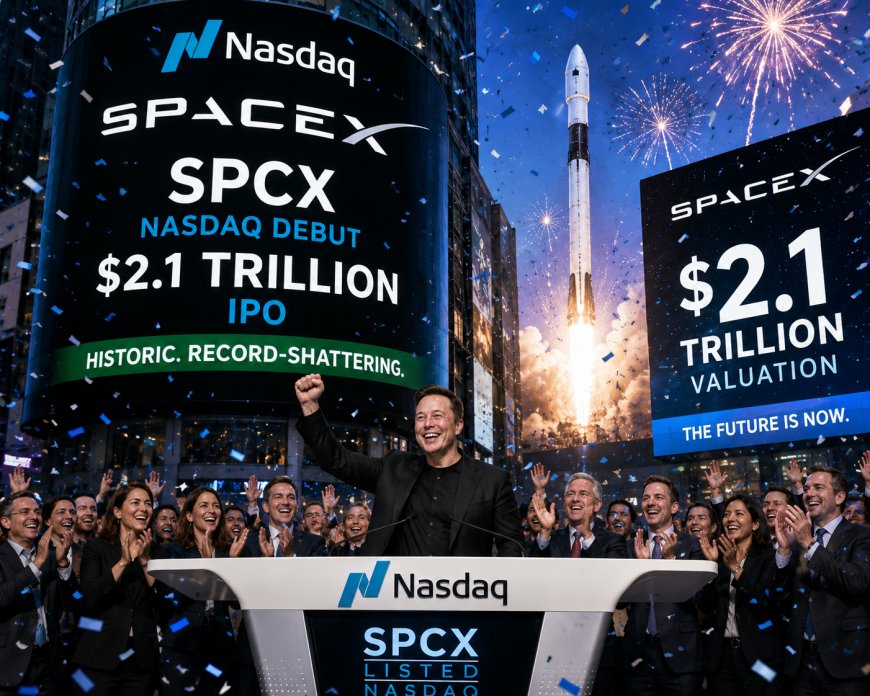
WALL STREET – In a historic milestone that bridges aerospace engineering and public finance, Elon Musk’s SpaceX completed its transition into the public markets on Friday under the ticker symbol SPCX, marking the largest initial public offering (IPO) in global history.
The company officially priced its shares at a fixed rate of $135 each, raising a staggering $75 billion right out of the gate. Once public trading commenced around midday, investor frenzy immediately took hold. The stock opened at $150—an instant 11% premium—and surged to an intraday peak of $176.52. By the closing bell, the equity stabilized at $160.95, representing a massive 19.22% single-day gain that propelled SpaceX’s total market capitalization past $2.1 trillion.
The blockbuster debut has simultaneously rewritten wealth records, officially making CEO Elon Musk the world’s first-ever trillionaire, with a net worth now exceeding $1.1 trillion fueled by his 42% equity stake in the enterprise.
Key Highlights of the SPCX Launch
-
Massive Investor Demand: The offering was heavily oversubscribed, attracting over $250 billion in orders—roughly 3.5 to 4 times the available shares.
-
A Concurrent Orbital Success: Coinciding with the Nasdaq opening bell, SpaceX successfully launched its Falcon 9 rocket on the Starlink 10-54 mission from Cape Canaveral, putting 29 more satellites into orbit.
-
Employee Windfalls: The record-breaking floatation has instantly turned an estimated 4,400 current and former employees into millionaires due to equity compensation plans.
Despite its current financial profile showing a full-year net loss of $4.94 billion for 2025 due to rapid AI infrastructure scaling and data center buildouts via its xAI division, Wall Street is aggressively pricing the company on its long-term future. With dominant commercial satellite footprints through Starlink and highly disruptive projects like Starship on the horizon, SpaceX proves that its financial valuation can defy gravity just as easily as its rockets.