













Supreme Court on Voting Rights: Is Aadhaar Enough for Citizenship Proof?
Supreme Court questions whether Aadhaar holders should automatically become voters, stressing Aadhaar isn't proof of citizenship during voter list hearings.
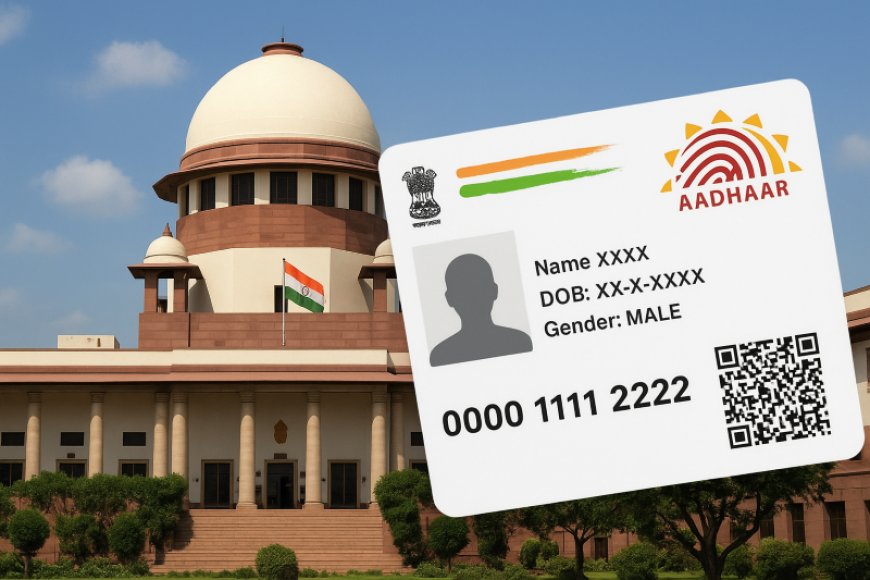
In a significant constitutional debate, the Supreme Court of India has raised an important concern — should a person holding Aadhaar be treated as eligible for voting even if they are not a citizen? The court emphasised that while Aadhaar ensures welfare benefits reach individuals, it cannot alone determine citizenship.
Aadhaar Cannot Mean Automatic Voting Rights
The bench pointed out that Aadhaar is issued to residents for welfare and identification purposes, not as proof of nationality. Just because someone obtains an Aadhaar card, the court said, it does not mean they can be added to the voters’ list.
Bench Led by Chief Justice Surya Kant
The matter is being heard by a bench led by Chief Justice Surya Kant, which is examining petitions questioning the Election Commission's Special Intensive Revision (SIR) of voter rolls in multiple states. The judges reiterated that Aadhaar “does not confer citizenship or absolute identity”, and hence cannot be the sole basis for voter eligibility.
Aadhaar Act Makes Citizenship Position Clear
The court relied on the Aadhaar Act which clearly states that the document is for identification and welfare schemes only, and it does not grant citizenship, domicile, or voting entitlement. The bench used a hypothetical scenario — if a migrant labourer from another country gets Aadhaar for ration, should they be allowed to vote?
Election Commission Has Power to Check Validity
The bench also clarified that the Election Commission (EC) is not merely an approving authority but has full jurisdiction to verify documents submitted with Form 6 for inclusion in electoral rolls. The EC, the court said, must scrutinize entries instead of acting like a “post office”.
Petitions Challenge SIR Process in Three States
The Supreme Court has fixed a hearing schedule for petitions specifically targeting SIR in Tamil Nadu, Kerala and West Bengal. The Election Commission has been directed to submit its response by December 1. Petitioners will then file rejoinders, after which the matter will be heard again.
Kapil Sibal Calls SIR Burdensome for Ordinary Citizens
Senior Advocate Kapil Sibal, appearing for petitioners, argued that SIR places an unconstitutional burden on common voters. Many people, especially senior citizens and the illiterate, may not understand documentation or form-filling, leading to wrongful deletion of names from voter rolls.
Aadhaar Is a Supporting Document, Not Final Proof
Sibal argued that Aadhaar still acts as a presumption of residence in favour of the voter. He said if the government believes a name should be deleted, the process must be transparent, justified and fair. “Take it away only through a proper process,” he insisted.
Court Highlights Importance of Removing Dead or Duplicate Voters
Justice Bagchi acknowledged the importance of cleansing electoral rolls, pointing out that public voter lists are easily accessible through panchayats and official portals. While Aadhaar is not citizenship proof, the integrity of voter data must still be maintained.
Hearing to Continue as Core Question Deepens
The case raises a core constitutional question — What defines a voter in India? With millions dependent on Aadhaar for identity, the court’s concern about misuse by non-citizens is crucial. Whether Aadhaar should be acceptable proof for voter eligibility remains open, and further hearing will continue.