










Rahul Gandhi Demands PM Modi's Apology Over Delhi Protest Crackdown on NEET Students
Rahul Gandhi has demanded an apology from Prime Minister Narendra Modi over the police action during the NEET protest in Delhi, questioning the government's response to students' concerns and the examination system.
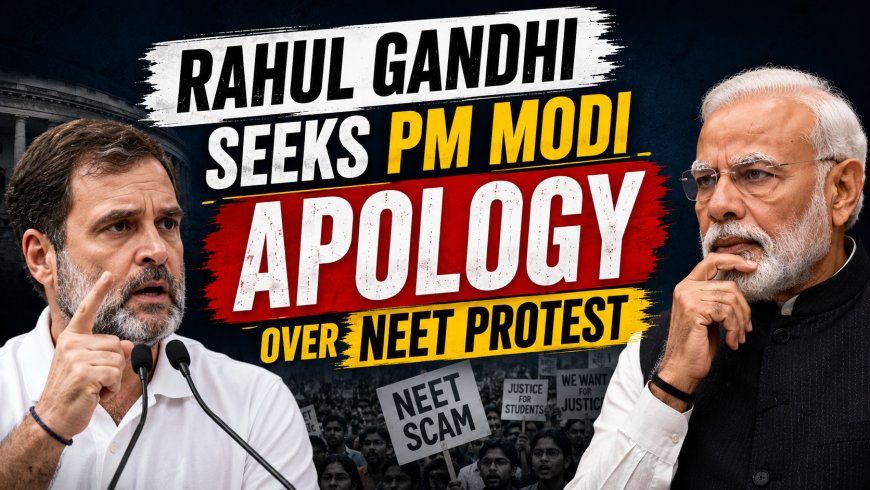
Leader of the Opposition Rahul Gandhi has strongly criticised Prime Minister Narendra Modi over the police action against protesters demonstrating against the alleged NEET-UG 2026 paper leak. Speaking outside Parliament, Rahul Gandhi questioned why the Prime Minister had not directly addressed the concerns of students and demanded that he apologise for the clashes that took place during Monday's 'Sansad Chalo' protest in Delhi.
His remarks came amid growing political debate over examination reforms, police action against protesters, and the government's handling of the NEET controversy.
Rahul Gandhi Questions PM Modi's Silence
Addressing the media, Rahul Gandhi said the Prime Minister had remained silent despite the seriousness of the issue.
He alleged that students across the country were protesting because they had lost confidence in the examination system and argued that the government should acknowledge their concerns instead of responding with police action.
According to Rahul Gandhi, the Prime Minister should apologise to students and ensure that such incidents are not repeated.
Criticism of the Examination System
Rahul Gandhi also targeted the country's education and examination framework, claiming that repeated controversies have damaged students' trust.
He said examination irregularities have become a national concern and stressed that reforms are needed to make recruitment and entrance examinations more transparent and reliable.
The Opposition has repeatedly raised concerns over alleged paper leaks and examination management in recent months.
Background: What Triggered the Protest?
The controversy began after allegations of irregularities in the NEET-UG 2026 examination.
Student groups and members of the Cockroach Janta Party (CJP) launched protests demanding:
- A transparent investigation into the alleged paper leak.
- Comprehensive reforms in the examination system.
- Accountability from authorities responsible for conducting competitive exams.
- The resignation of Union Education Minister Dharmendra Pradhan.
The movement later expanded into the 'Sansad Chalo' march organised in Delhi.
Violence During the 'Sansad Chalo' March
On Monday, hundreds of protesters attempted to march from Jantar Mantar towards Parliament.
Delhi Police stopped the procession near security barricades around Parliament, leading to clashes between protesters and police personnel.
Authorities used tear gas and lathis to disperse the crowd after some demonstrators allegedly attempted to breach barricades.
The incident quickly became one of the biggest political issues of the ongoing Monsoon Session.
Police and Protesters Give Different Accounts
Delhi Police stated that more than 118 police personnel, including senior officers, were injured during the clashes.
Police also alleged that protesters threw stones, damaged public property and attempted to force their way into restricted areas.
On the other hand, protest organisers claimed that around 60 demonstrators were injured and accused the police of using excessive force against peaceful protesters.
Both versions of the incident continue to be debated publicly.
JP Nadda Meets Protest Representatives
Amid the escalating controversy, Union Health Minister J. P. Nadda met a delegation of CJP leaders, including Ashutosh Ranka and Saurav Das.
According to party representatives, they submitted a memorandum highlighting their demands, including:
- Resignation of Dharmendra Pradhan.
- Examination reforms.
- Compensation for families of students allegedly affected by the controversy.
- Release of activist Sonam Wangchuk, who remains hospitalised.
Government officials described the discussions as cordial and said dialogue would continue.
Issue Echoes Inside Parliament
The protest also became a major issue inside Parliament, where Opposition parties criticised the government's handling of the demonstrations.
Several lawmakers demanded discussions on examination reforms, student welfare and the police response, while government leaders defended the security measures taken near Parliament.
The issue contributed to repeated disruptions during the Monsoon Session.
Government's Stand Remains Firm
The government has maintained that law enforcement agencies acted to protect security around Parliament after protesters attempted to enter restricted areas.
Officials have also reiterated that investigations into the alleged NEET paper leak are continuing and that legal action has already been initiated against those accused of involvement.
Meanwhile, Prime Minister Narendra Modi has separately described preventing paper leaks as a "national responsibility" and called for strict punishment for those found guilty.
Final Thoughts
Rahul Gandhi's demand for an apology from Prime Minister Narendra Modi has further intensified the political debate surrounding the NEET paper leak controversy and the Delhi protest. While the Opposition has accused the government of failing to address students' concerns, the Centre maintains that investigations are underway and that maintaining law and order around Parliament was necessary. With Parliament in session and education reforms remaining a major national issue, the debate is expected to continue in the coming days.