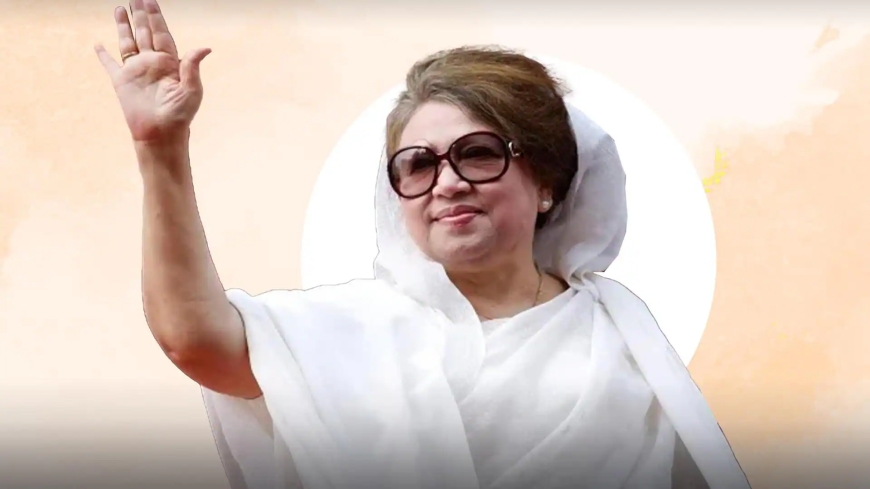
Former Bangladesh Prime Minister Khaleda Zia, one of the most influential figures in the country’s political history, passed away early Tuesday after a prolonged illness. She was 80. Zia’s death has renewed focus on her long and complex political legacy, particularly her often fraught relationship with India. From strong rhetoric warning against “slavery” to later assurances on counter-terror cooperation, Zia’s India policy reflected a blend of nationalism, pragmatism, and political strategy.
First Woman Prime Minister of Bangladesh
Khaleda Zia made history as Bangladesh’s first woman prime minister, serving two full terms from 1991 to 1996 and again from 2001 to 2006. As chairperson of the Bangladesh Nationalist Party (BNP), she played a decisive role in shaping the country’s political institutions. She is widely credited with restoring the parliamentary system in 1991, replacing the presidential model and consolidating executive authority under the prime minister.
Two Women Who Dominated Politics
For over three decades, Bangladeshi politics was largely defined by the rivalry between Khaleda Zia and Sheikh Hasina, the Awami League leader and five-time prime minister. Their rivalry went beyond domestic politics and extended into contrasting visions of foreign policy, especially in relation to India.
Early Adversarial Stance on India
In her early years, Zia adopted a cautious and sometimes confrontational approach toward India. She consistently emphasised Bangladeshi sovereignty and resisted what she described as excessive Indian influence. This stance resonated strongly with nationalist sentiment within Bangladesh and helped define the BNP’s political identity.
Opposition to Transit and Connectivity
One of the most visible points of contention was India’s request for overland transit access to its northeastern states through Bangladesh. Zia opposed these proposals both as prime minister and later as leader of the opposition, arguing they compromised national security. She famously described toll-free access for Indian trucks as equivalent to “slavery,” a remark that became emblematic of her hardline position.
Treaties, Water Disputes, and Farakka
Zia also opposed the renewal of the 1972 Indo-Bangladesh Friendship Treaty, arguing it constrained Bangladesh’s strategic autonomy. Water-sharing disputes, particularly over the Teesta River and criticism of India’s Farakka Barrage, further strained ties. At one point, she accused India of manipulating water flows to worsen flooding in Bangladesh, adding to diplomatic friction.
China Defence Ties and Indian Concerns
During her 2001–06 term, Zia pursued closer defence cooperation with China, signing deals that made Beijing a key supplier of military hardware to Bangladesh. India viewed these moves with concern, seeing them as altering the regional security balance. Relations further deteriorated amid Indian allegations that militant groups targeting its northeastern states found sanctuary in Bangladesh.
Pragmatism Beneath the Rhetoric
Despite the sharp rhetoric, Zia’s policy was not entirely inflexible. The Tin Bigha Corridor agreement, which ensured Bangladesh’s access to the Dahagram-Angarpota enclave, reflected pragmatic engagement with India. In 2006, she also signed revised trade and anti-drug smuggling agreements during an official visit to New Delhi.
Shift After 2012 and Anti-Terror Pledge
A notable shift came after 2012, when Zia visited Delhi and met then Prime Minister Manmohan Singh. She pledged that future BNP governments would act firmly against terrorist groups operating from Bangladeshi soil. This assurance was widely interpreted as a strategic recalibration ahead of the 2014 elections.
Later Engagements and Partial Thaw
Zia’s engagement with India continued after 2014, including a meeting with Narendra Modi in Dhaka in 2015. Although tensions persisted, particularly over human rights and border issues, there were signs of cautious engagement. After Sheikh Hasina’s ouster in August 2024, the BNP signalled interest in “equal and respectful” ties with India.
India’s Response to Her Passing
Following news of her death, Prime Minister Modi expressed condolences, recalling their 2015 meeting and acknowledging her role in Bangladesh’s public life and bilateral relations. The message was welcomed by the BNP as a gesture of goodwill, underscoring the complex but enduring diplomatic ties between the two countries.
Conclusion
Khaleda Zia’s relationship with India was marked by sharp criticism, strategic bargaining, and eventual recalibration. While often positioned as sceptical of Indian influence, she also demonstrated pragmatism when national interests aligned. Her passing closes a defining chapter in Bangladesh’s political history, leaving behind a legacy that will continue to shape discussions on India-Bangladesh relations for years to come.