











CJP Protest Day 3: Rahul Gandhi Detained, Sonam Wangchuk Shifted as Political Pressure Mounts
The CJP protest entered its third day with Rahul Gandhi briefly detained outside the Prime Minister's residence, Sonam Wangchuk shifted to a private hospital, and political pressure growing over the NEET paper leak issue.
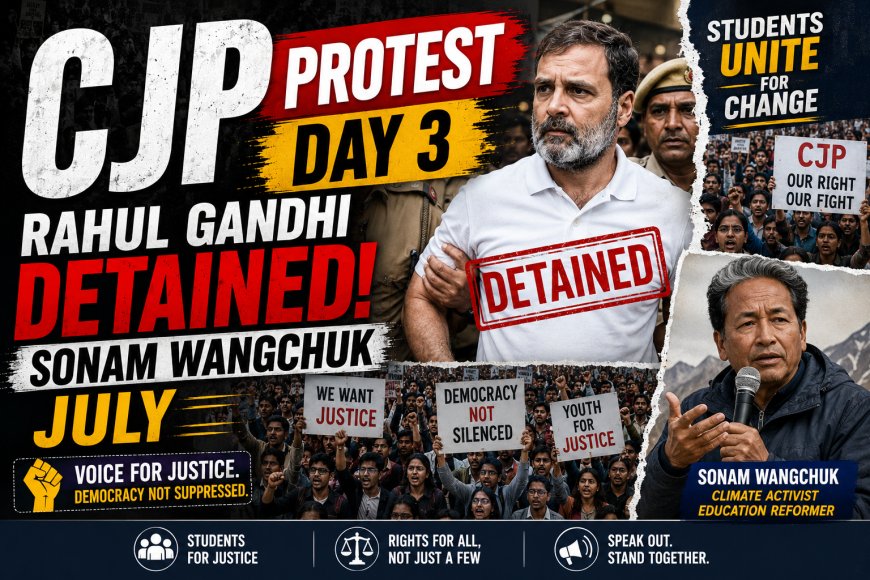
The Cockroach Janata Party (CJP) protest over the alleged NEET paper leak entered its third consecutive day, with fresh political developments unfolding in Delhi. What began as a student-led movement demanding examination reforms has now evolved into a nationwide political issue, drawing support from several opposition leaders and increasing pressure on the Central Government.
Tuesday witnessed a series of dramatic developments, including Rahul Gandhi's temporary detention, Sonam Wangchuk's transfer to a private hospital, high-level meetings between government ministers and protesters, and protests spreading across multiple states.
Thousands Continue Protest at Jantar Mantar
Despite heavy police deployment and Monday's violent clashes, thousands of students and supporters once again gathered at Jantar Mantar to continue the agitation.
Many participants who were unable to attend the initial 'Sansad Chalo' march joined the demonstration on the second day, demanding accountability over alleged examination irregularities and reforms in India's entrance examination system.
The protest remained largely peaceful as organisers vowed to continue their movement until their demands are addressed.
Rahul Gandhi and Priyanka Gandhi Detained During Protest
One of the biggest political moments of the day came when Rahul Gandhi, Priyanka Gandhi Vadra, and several Congress leaders staged a sit-in outside Prime Minister Narendra Modi's official residence.
The Congress leaders demanded action over the police crackdown on student protesters and sought the resignation of Union Education Minister Dharmendra Pradhan.
After nearly three hours of protest, Delhi Police detained Rahul Gandhi, Priyanka Gandhi, and several opposition leaders before later releasing them.
The incident further intensified the political confrontation surrounding the ongoing student movement.
Opposition Rallies Behind Student Protest
Support for the CJP protest continued to grow as leaders from several opposition parties openly backed the agitation.
Among those expressing solidarity were:
- Rahul Gandhi
- Priyanka Gandhi Vadra
- Arvind Kejriwal
- Akhilesh Yadav
- Sharad Pawar
- Supriya Sule
- Uddhav Thackeray
- Mamata Banerjee
- Leaders from Kerala, West Bengal, Maharashtra and other states
Many opposition leaders accused the government of responding to student concerns with force instead of dialogue.
JP Nadda Meets Injured Students and Protest Leaders
Union Health Minister J. P. Nadda visited Ram Manohar Lohia (RML) Hospital to meet students injured during Monday's clashes.
Later, he also met representatives of the Cockroach Janata Party, who submitted a memorandum listing their demands.
According to protest leaders, the meeting focused on examination reforms, student welfare, and accountability over the alleged paper leak controversy.
Government officials described the discussions as constructive, although no formal decisions have been announced.
PM Modi Reiterates Tough Stand on Paper Leaks
During the NDA Parliamentary Party meeting, Prime Minister Narendra Modi reportedly assured party members that the government remains committed to taking strict action against everyone involved in the alleged NEET paper leak.
He also urged states to cooperate with the Centre in strengthening examination security and preventing similar incidents in the future.
The Prime Minister described protecting students' futures as a national priority.
Sonam Wangchuk Shifted to Private Hospital
Environmental activist Sonam Wangchuk, who has been on a prolonged hunger strike supporting the movement, received permission from the Delhi High Court to shift from Safdarjung Hospital to Medanta Hospital.
The court directed Medanta to constitute a dedicated medical team to continuously monitor his condition.
The Centre agreed to the transfer but requested that Wangchuk not seek discharge against medical advice once admitted to the private hospital.
Parliament Witnesses Repeated Disruptions
The protest also echoed inside Parliament.
Opposition parties demanded an immediate discussion on the alleged NEET paper leak, examination reforms, and the police action against student protesters.
Frequent protests by opposition MPs led to repeated disruptions during proceedings, making the issue one of the central topics of the Monsoon Session.
CJP Removes Its National Spokesperson
In another unexpected development, the Cockroach Janata Party removed its spokesperson Vijeta Dahiya after videos circulated online allegedly showing him leaving the protest during the police crackdown.
The controversy gained attention on social media, prompting the party to announce his removal in an effort to maintain public confidence in the movement.
What Happens Next?
With the protest entering its third day, uncertainty remains over how the situation will evolve.
Student organisations continue to demand examination reforms and accountability, while the government has reiterated its commitment to investigating the alleged paper leak and strengthening the examination system.
Political observers believe the issue is likely to remain a major topic both inside Parliament and outside in the coming days.
Final Thoughts
The CJP protest has now transformed from a student-led movement into one of the biggest political developments of the ongoing Monsoon Session. With Rahul Gandhi's detention, Sonam Wangchuk's hospital transfer, opposition parties rallying behind the protesters, and the government defending its actions, the debate over examination reforms has reached a new level. As discussions continue in Parliament and demonstrations persist on the streets, the coming days could prove crucial in determining whether dialogue leads to meaningful reforms or whether the protests gather even greater momentum.