











BRICS Summit 2026 Ends: Modi-Xi Meeting, Key Decisions and New Delhi Declaration
BRICS Summit 2026 ends in New Delhi. Know what happened at the India summit, key outcomes of the New Delhi Declaration, Modi-Xi meeting and major decisions.
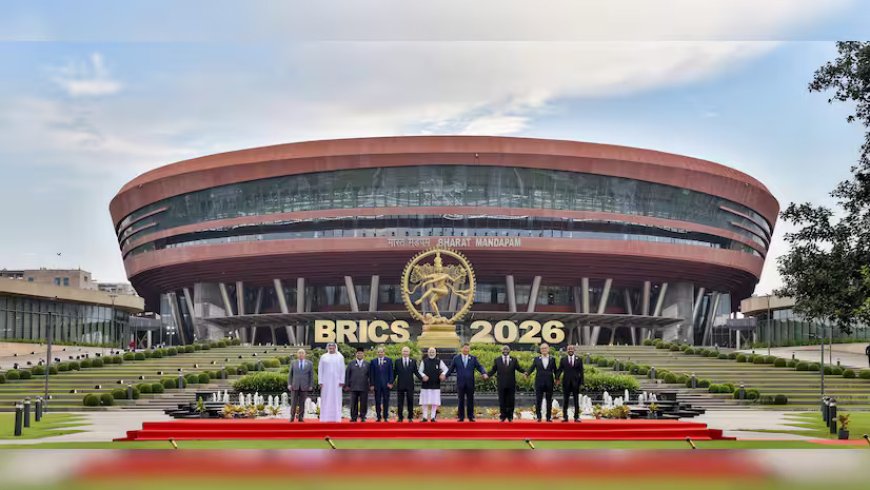
The BRICS Summit 2026 has concluded in New Delhi after two days of high-level discussions involving leaders of the expanded BRICS grouping. Hosted by India on September 12 and 13, the summit focused on global governance, economic cooperation, geopolitical tensions, technology, critical minerals, climate change and a stronger role for the Global South.
The summit also attracted enormous attention because of Chinese President Xi Jinping's visit to India and his meeting with Prime Minister Narendra Modi. Xi's India visit was his first since 2019 and came against the backdrop of years of tensions between the two countries following the 2020 Galwan Valley clash.
Here are the biggest takeaways from the BRICS Summit 2026.
BRICS Summit 2026: What Happened in New Delhi?
The 18th BRICS Summit was held at Bharat Mandapam in New Delhi under India's chairship.
The central theme of India's presidency was “Building for Resilience, Innovation, Cooperation and Sustainability.” Leaders discussed how BRICS could increase practical cooperation while giving developing and emerging economies a stronger voice in global decision-making.
The summit concluded with the adoption of the New Delhi Declaration, which addressed a wide range of international and economic issues.
Prime Minister Narendra Modi described BRICS as a solutions-oriented platform and stressed that commitments made by the grouping should translate into concrete action.
Modi-Xi Meeting Becomes Major Highlight
One of the most closely watched events was the meeting between PM Narendra Modi and Chinese President Xi Jinping.
The two leaders discussed the India-China relationship, including maintaining peace and tranquillity along the border. Modi emphasized the importance of mutual respect, mutual sensitivity and mutual interest in developing bilateral relations.
The meeting was particularly significant because relations between India and China have remained sensitive since the Galwan Valley confrontation.
The two sides also discussed expanding economic and people-to-people exchanges, while trade and market-access issues remained part of the broader bilateral conversation.
Xi's presence in New Delhi therefore became one of the defining diplomatic moments of the summit.
New Delhi Declaration: Major Decisions
The New Delhi Declaration 2026 was among the most important outcomes of the summit.
The declaration addressed international conflicts, terrorism, trade barriers, sanctions, global governance and economic cooperation.
BRICS members called for diplomatic approaches to conflicts and expressed support for greater representation of developing nations in international institutions, including reforms to global governance structures.
The declaration also emphasized cooperation in areas including:
- Trade and investment
- Energy security
- Food security
- Artificial intelligence
- Climate action
- Digital technologies
- Health
- Agriculture
- Infrastructure
- Skills and youth development
Another important area was increasing the use of local currencies and stronger cross-border payment mechanisms to facilitate trade among BRICS members.
PM Modi Warns Against Weaponisation of Technology
Technology emerged as a major theme at the summit.
Prime Minister Modi warned that the weaponisation of technology and critical minerals could create new obstacles to global development and economic stability.
India also pushed for practical cooperation in emerging technologies and solutions that can benefit developing countries.
The message from New Delhi was that technological development should remain inclusive and accessible rather than becoming another source of geopolitical division.
Xi Jinping Announces New AI Initiative
China's President Xi Jinping also used the summit to promote greater cooperation in artificial intelligence.
Xi announced initiatives including a BRICS AI Open Source Zone and proposed a Service Trade Forum for 2027 as part of China's efforts to strengthen the expanded grouping's economic and technological cooperation.
The focus on AI is significant because BRICS countries increasingly see technology as a major component of future economic growth.
For India, the discussion also aligns with its broader push to make AI and digital technologies useful for developing economies.
BRICS Pushes for a Stronger Global South
Another major message from the summit was that developing countries should have a greater role in shaping international rules.
PM Modi argued that the Global South should move from being rule-takers to rule-shapers and called for reforms to global institutions.
India also proposed mechanisms aimed at ensuring that initiatives launched under one BRICS presidency continue rather than losing momentum when leadership rotates to another country.
This reflects India's attempt to make BRICS more focused on long-term implementation rather than only annual declarations.
BRICS and Global Conflicts
The summit took place against a complicated international backdrop, including conflicts in the Middle East and the Russia-Ukraine war.
The joint declaration called for de-escalation and diplomatic solutions while addressing concerns related to unilateral sanctions, trade protectionism and global instability.
However, the summit also highlighted the differences between BRICS members. With countries such as Iran, Saudi Arabia and the UAE inside the expanded grouping, reaching consensus on geopolitical issues remains challenging.
The ability of India to bring members with different strategic interests around a common declaration was therefore itself considered an important diplomatic outcome.
What Happens Next?
India has now handed over the BRICS chairship to China, which will host the next summit.
The challenge for the grouping will be turning the commitments made in New Delhi into measurable outcomes in trade, technology, finance, health and sustainable development.
The 2026 summit also showed that BRICS is no longer simply an economic grouping of a few emerging economies. Its expansion has increased its geopolitical weight while simultaneously making consensus more complicated.
Final Thoughts
The BRICS Summit 2026 in New Delhi ended with a strong focus on Global South cooperation, economic coordination and reform of international institutions.
The Modi-Xi meeting was one of the biggest diplomatic highlights, while the New Delhi Declaration provided the broader framework for cooperation on trade, technology, energy, health, climate and global governance.
For India, the summit was also an opportunity to demonstrate its diplomatic influence at a time of major global uncertainty.
With China taking over the BRICS chairship next, the focus will now shift from what was agreed in New Delhi to what the expanded BRICS grouping actually delivers.